A Numismatic Icon of Post-Napoleonic Restoration
By Denis Richard, Coin Photography Studio
December 30, 2025
🕒 10-minute read
The 1816 Austrian One Kreuzer
The history of the 1816 Austrian Kreuzer is inextricably linked to the Habsburg Monarchy’s desperate efforts to reclaim economic sovereignty and political legitimacy in the wake of the Napoleonic Wars. This coinage, although seemingly humble in its copper composition, represented the physical manifestation of the 1816 Patent. This legislative cornerstone sought to stabilize a currency ravaged by decades of hyperinflation, state bankruptcy, and the fragmentation of the Holy Roman Empire.
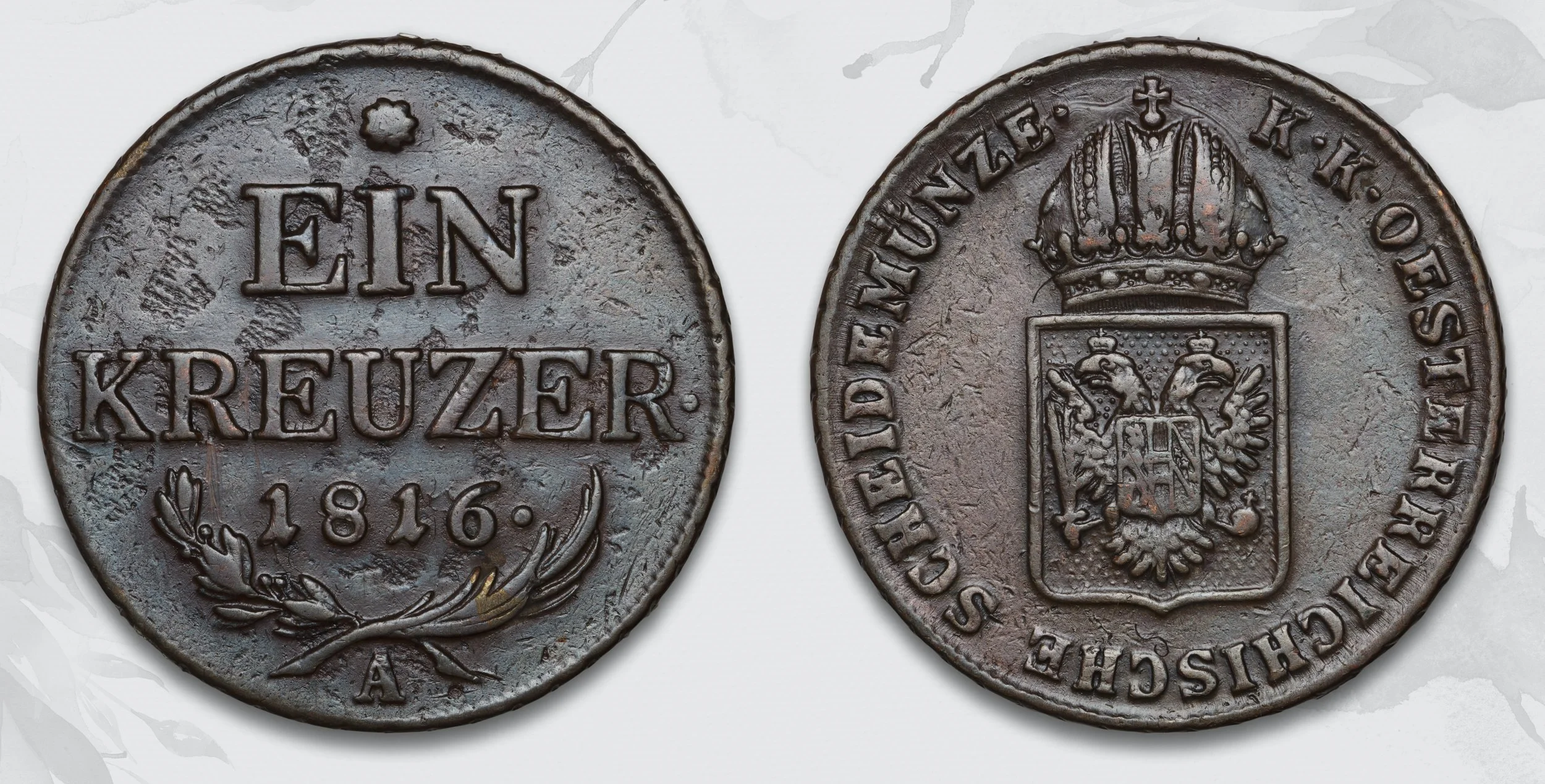
As a circulating medium, the 1816 Kreuzer was intended to be the "anchor" of the daily economy, a reliable token of value for a populace that had seen their paper savings evaporate by the devaluation of the Bancozettel. Its design, production, and enduring "frozen date" provide a window into the transition from the late Baroque imperial structure to the more centralized, bureaucratic Austrian Empire of the 19th century.
The Economic Crucible: Bankruptcy and the Reform of 1816
To appreciate the significance of the 1816 Kreuzer, one must first examine the catastrophic economic landscape from which it emerged. Throughout the Napoleonic Wars (1792–1815), Austria was in a near-constant state of military mobilization, necessitating enormous financial outlays that the imperial treasury could not sustain through traditional taxation alone. The government’s primary solution was the issuance of massive quantities of paper money, known as Bancozettel (Vienna Banknotes). By 1811, the circulation of these notes had reached an unsustainable peak, forcing the state to declare a partial bankruptcy.

Emperor Francis I, left, who had ascended to the throne as Francis II of the Holy Roman Empire before reconstituting his realm as the Austrian Empire in 1804, took a pragmatic, albeit harsh, view of this fiscal collapse. He famously asserted that a state bankruptcy was simply another form of tax, one that must be arranged so that the burden of loss was distributed across all social strata. However, the continued strain of the War of Liberation (1813–1814) further eroded the value of the new currency, prompting the introduction of Anticipationsscheine (anticipation notes), which only compounded public distrust of paper money.
The year 1816 marked the definitive attempt to end this cycle of instability. On June 1, 1816, the Privilegirte Österreichische Nationalbank (Privileged Austrian National Bank) was founded with the explicit goal of establishing a monopoly on banknote issuance and ensuring that sufficient reserves would back future paper money to prevent forced exchange rates. The 1816 Kreuzer was the copper "small change" accompaniment to this grand institutional reform. As a Scheidemünze (divisional coin), it was guaranteed in value by the state rather than by its intrinsic metal content, making it a critical tool for providing the liquidity necessary for the post-war recovery.
Iconography and Design: The Meaning of the Obverse
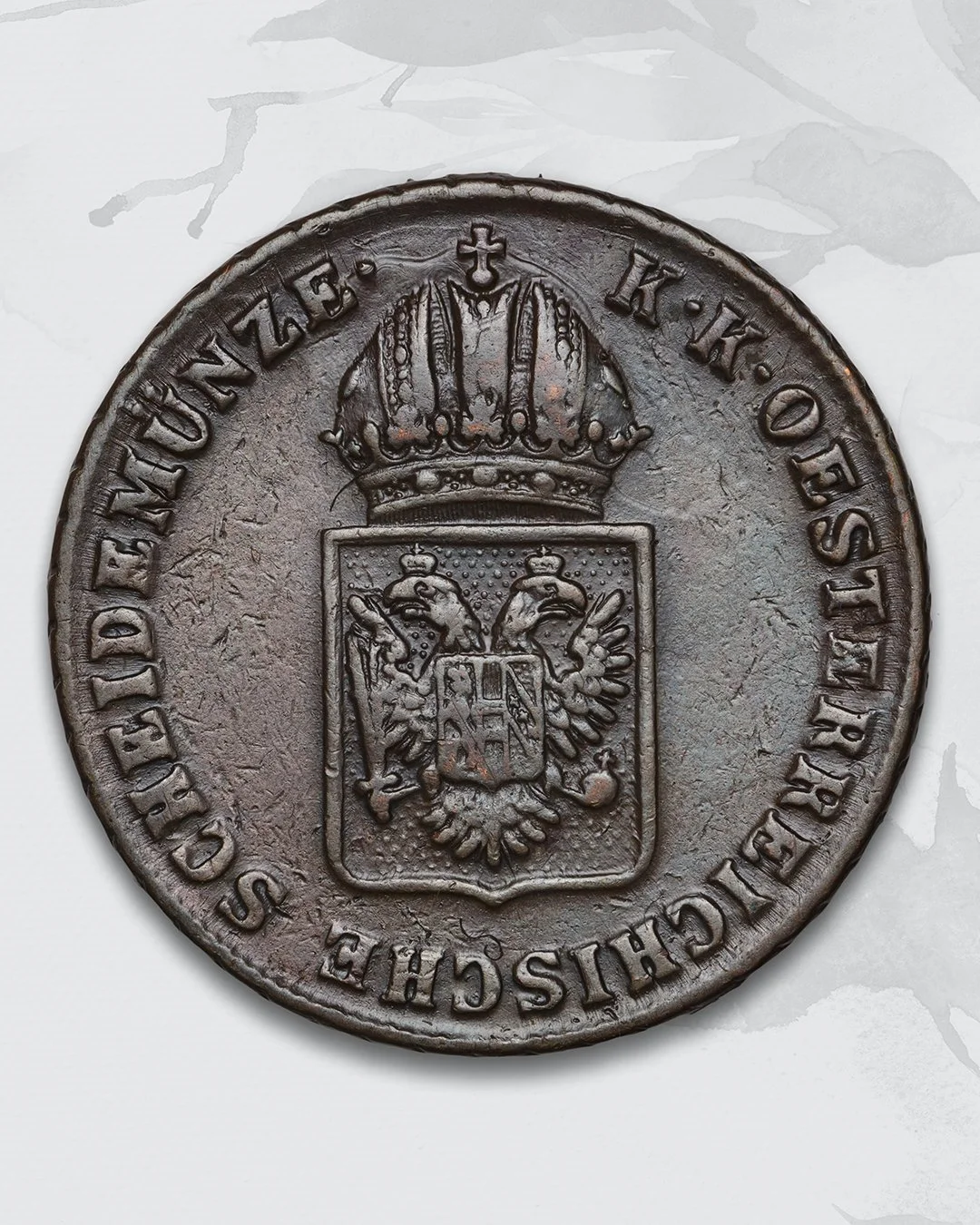
The obverse of the 1816 Kreuzer is dominated by a crowned shield, a design that avoided the more expensive and time-consuming process of engraving the Emperor’s portrait for every denomination. This choice was particularly practical for a mass-produced copper issue intended for high circulation.
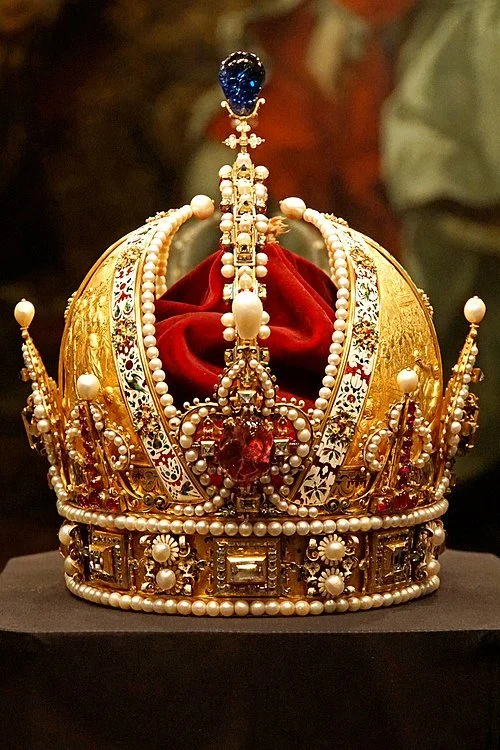
The Imperial Crown and Shield
The shield is surmounted by the Austrian Imperial Crown, specifically the Crown of Rudolf II, shown on the right, which was designated the official state crown of the Austrian Empire in 1804. This crown symbolized the divine right of the Habsburgs and their continuity of rule despite the dissolution of the Holy Roman Empire.
This file is in the public domain, licensed under the Creative Commons Attribution-Share Alike 2.0 Generic license.
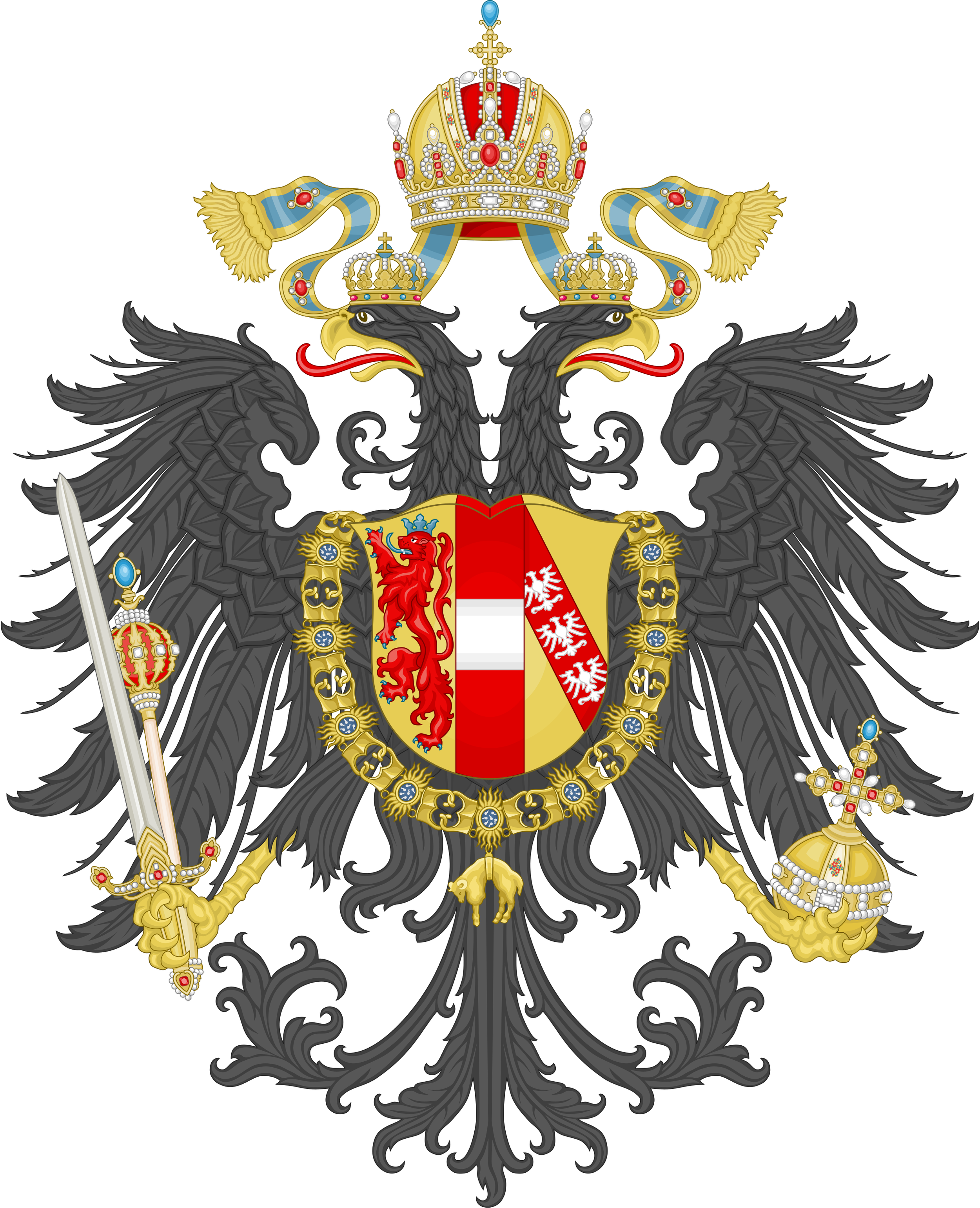
Lesser Coat of arms as Emperor of Austria
(1815–1835)
Within the shield lies the heraldic heart of the monarchy. While the 1 Kreuzer features a simplified crowned shield, it represents the arms of the Austrian Empire, often centered around the double-headed eagle.
The double-headed eagle itself is an emblem of ancient provenance, adopted by the Habsburgs to signify their status as successors to the Roman and Byzantine emperors. Historically, the two heads were interpreted as representing spiritual and temporal power, or dominion over the East and West. Following 1806, the Habsburgs removed the nimbus (halo) from the eagle's heads and added an inescutcheon featuring the arms of Habsburg-Lorraine, surrounded by the Order of the Golden Fleece. Even in the simplified form seen on the 1816 Kreuzer, the crowned shield served as a powerful mnemonic for the Emperor's "Imperial and Royal" status.
The Legend: K.K. Oesterreichische Scheidemünze
Encircling the shield is the Latin script legend: K·K·OESTERREICHISCHE SCHEIDEMÜNZE·. The abbreviation "K.K." (for Kaiserliche und Königliche) is a foundational descriptor of the Austrian state, indicating its dual status as an Empire (Kaisertum) and a collection of Kingdoms (Königreiche) such as Hungary and Bohemia. The term Scheidemünze is critical to understanding the coin’s economic function. It identifies the Kreuzer as a "token" or "divisional" coin, distinguishing it from Kurantmünze (full-value coins) like the silver Thaler. This designation was a legal assurance that the coin's value was decreed by the state, regardless of the fluctuating price of copper on the world market.
The Reverse: Denominational Clarity and Esoteric Stars
The reverse of the 1816 Kreuzer was designed for maximum legibility in a polyglot empire where literacy rates varied significantly. The design consists of four primary elements: an eight-pointed star, the denomination, the date, and a surrounding wreath.
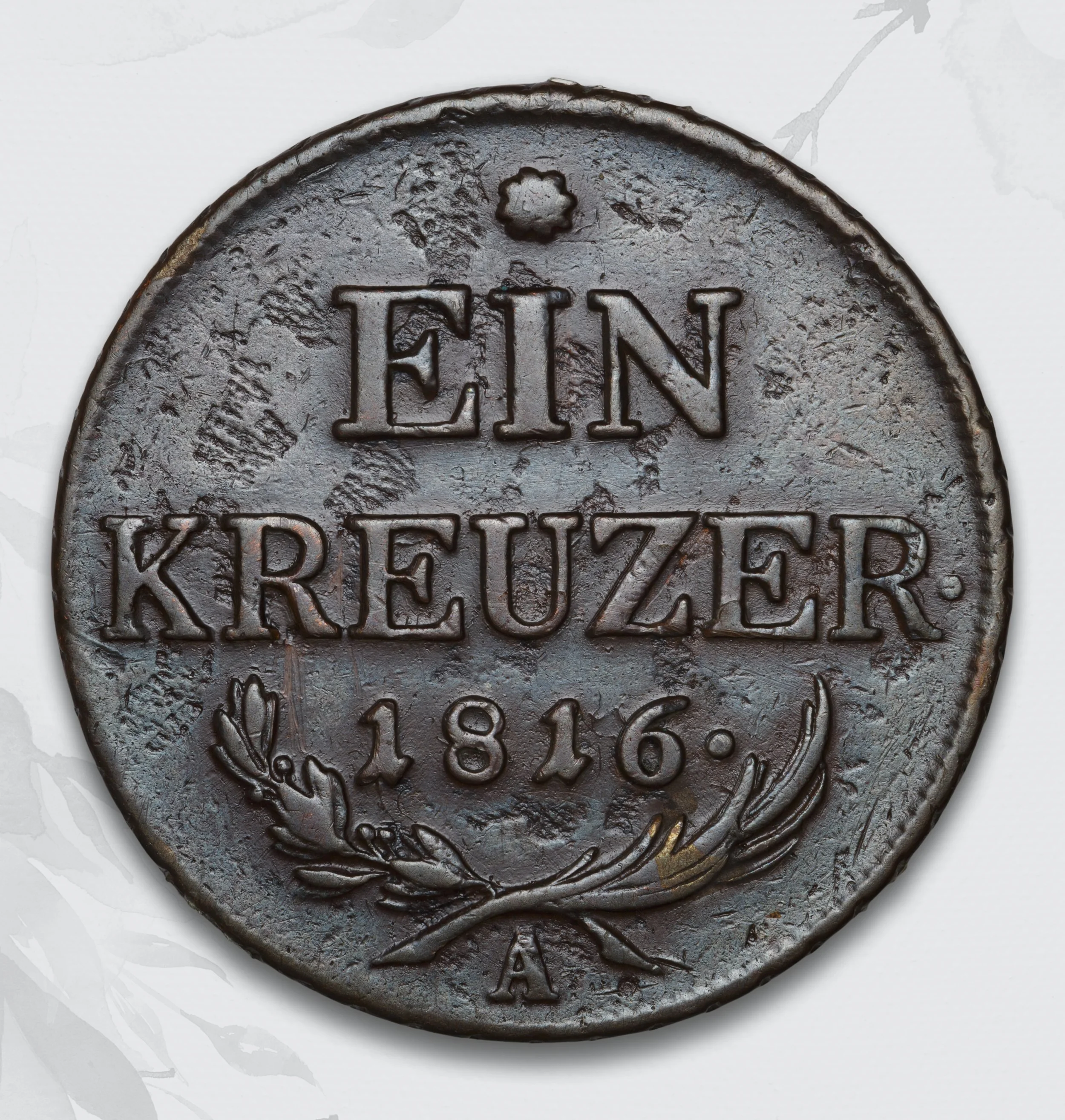
The Eight-Pointed Star and the Wreath
Positioned at the very top of the reverse is an eight-pointed star. In early 19th-century semiotics, the eight-pointed star was a potent symbol of guidance and rebirth. Often identified as the Morning Star (Venus), it symbolized the victory of light over darkness and the promise of a "new beginning" for the Austrian state following the Napoleonic "darkness". In a spiritual sense, it was considered a magical sign of happiness and fertility, perhaps reflecting the monarchy’s hope for a growing, stable population to rebuild the war-torn lands.
Surrounding the central text is a wreath, typically composed of laurel or oak leaves. In classical tradition, a wreath symbolized eternity, victory, and civic virtue. On the 1816 Kreuzer, it functions as a framing device that elevates the simple copper coin to imperial dignity. Numismatists often study the variation in the berries found within these wreaths; smaller berries frequently indicate restrikes or later dies, while larger berries are associated with the initial strikes of 1816.
Denominated Value and the Etymology of "Kreuzer"
The reverse inscription typically reads EIN KREUZER, followed by the date 1816 and the mint mark. The name "Kreuzer" is deeply historical, derived from the German word Kreuz (cross). The denomination was first minted in the late 13th century (c. 1271) and featured a double cross (the combination of a standard and St. Andrew's cross) on its face. While the 1816 issue replaced the cross with the imperial shield and star, the name remained a familiar marker of value for the general public. The 1 Kreuzer was valued at 1/60th of a silver Gulden, making it a foundational unit for the Gulden currency system that persisted in Austria until 1857.
The "Frozen Date" Phenomenon: A Numismatic Anomaly
The most unique and frequently discussed feature of the 1816 Austrian copper coinage is the "frozen date". Although every coin in this series bears the year 1816, they were actually struck continuously for thirty-six years, with production only ceasing in 1852. This was not an error but a deliberate policy choice by the Austrian Mint.
Rationale for the 1816 Date
The primary reason for freezing the date was to maintain public confidence in the monetary reforms initiated in 1816. For the average subject, 1816 marked the return of stable money and the end of the hyperinflationary crisis of the war years. By keeping the date constant, the government ensured that the coins remained instantly recognizable and "trusted" as part of the official stabilization program.
From an administrative perspective, the frozen date was a measure of extreme efficiency. Creating new dies with updated years was a time-consuming and expensive process, especially for a mass-produced copper coin that needed to be struck by the tens of millions across several different mints. By reusing the 1816 master dies, the mints significantly reduced their overhead costs. This practice has a direct precedent in the Maria Theresa Thaler, which has carried the 1780 date since her death to ensure its acceptance in international trade markets. For the 1816 Kreuzer, the result was a staggering total mintage of over 54 million, making the coin one of the most common artifacts of the mid-19th-century Habsburg economy.
The Kreuzer in Daily Life
The coin’s purchasing power in 1816 was significant for small items. It could buy a loaf of bread, a small portion of meat, or a measure of beer in a Viennese tavern. In rural areas, the Kreuzer was the primary unit for settling local debts and paying church tithes. The fact that it was a Scheidemünze meant that, while the Emperor was legally obligated to accept it for taxes at face value, no one could lawfully compel another to take more than a certain amount of copper for a large debt—a protection against the cumbersome nature of bulk copper transactions.
Comparative Analysis: Austria vs. Great Britain in 1816
It is insightful to compare the Austrian reform of 1816 with the contemporary "Great Recoinage" of 1816 in the United Kingdom. Both nations were emerging from the Napoleonic Wars with shattered economies and a desperate need for stable currency.
In Britain, the reform was led by the Master of the Mint, William Wellesley-Pole, and engravers such as William Wyon and Benedetto Pistrucci. The British effort was focused on the gold standard and the introduction of the sovereign, a coin of high intrinsic value designed to support London's role as the world's financial center.
The Austrian effort, by contrast, was more focused on internal stabilization and on managing a massive, diverse domestic population. While Britain produced millions of silver shillings and gold sovereigns, Austria produced tens of millions of copper Kreuzers. Both nations used 1816 as a "reset" year, and both nations produced designs that were so successful they remained essentially unchanged for decades—the British shilling's size and weight remained constant until the 1970s, much like the 1816 Kreuzer's design remained the standard until the mid-century reforms.
A Symbol of Resilience
The 1816 Austrian copper Kreuzer is a coin that tells the story of an empire's survival. It emerged from bankruptcy and war, yet it became the most recognizable symbol of daily life in the Habsburg lands for over a generation. Its date of 1816 freezes the moment the monarchy reclaimed its economic footing and transitioned into a modern imperial state.
For the numismatist, the coin offers a rich field of study—from the rare Transylvanian mint marks to the sophisticated engravings of Johann Baptist Harnisch. For the historian, it is a primary source documenting the "Metternich System" in action—a conservative, centralized authority attempting to provide order and uniformity to a chaotic world.
Ultimately, the 1816 Kreuzer succeeded in its mission. It provided the small-scale liquidity that allowed the Austrian Empire to recover and flourish during the Biedermeier period, supporting a growing middle class and maintaining the "monarchical principle" until the seismic shifts of 1848. Its enduring presence in coin collections today—often worn and darkened by time—is a testament to the millions of hands it passed through and the foundational role it played in the 19th-century European economy. In the annals of numismatic history, few copper coins have carried so much weight, both literally and symbolically, as the 1816 Austrian Kreuzer.
The Photography
All coin photography by Denis Richard using a hybrid axial lighting system developed by Coin Photography Studio. It is easy to bring out the beautiful colours of any coin with this system. We believe in providing high-quality images that accurately depict the coins they represent.
A Final Thought
Thank you for reading this blog post! I hope you found it informative and enjoyable.
If you're interested in similar topics, be sure to check out our other posts on numismatic subjects. From coin history to coin photography, we have lots to offer.
Don't forget to leave a comment below with your thoughts and feedback. We love hearing from our readers and it helps us improve our content.
Thank you again for your support and we hope to see you back here soon! Happy collecting!
Works cited
1. accessed December 30, 2025, https://www.ebay.com/shop/ein-kreuzer-1816-coin?_nkw=ein+kreuzer+1816+coin#:~:text=The%20Ein%20Kreuzer%20coin%20from,territories%20in%20the%20Austrian%20Empire.
2. Two turbulent centuries: Lessons from Austria's monetary policy ..., accessed December 30, 2025, https://www.suerf.org/publications/suerf-policy-notes-and-briefs/two-turbulent-centuries-lessons-from-austrias-monetary-policy-1816-2016/
3. The History of Austria as Reflected in its Paper Money - CoinsWeekly, accessed December 30, 2025, https://new.coinsweekly.com/nations/austria/the-history-of-austria-as-reflected-in-its-paper-money/
4. Austria 1 Kreuzer 1816 A - | Katz Auction, accessed December 30, 2025, https://katzauction.com/lot/585739
5. Austria/Austrian Empire 1 Kreuzer 1816, High Grade. - Coins Auctioned, accessed December 30, 2025, https://www.coins-auctioned.com/products/austriaaustrian-empire-1-kreuzer-1816-high-grade-20163
6. Austrian Empire - Wikipedia, accessed December 30, 2025, https://en.wikipedia.org/wiki/Austrian_Empire
7. Coinage Act 1816 - Chards, accessed December 30, 2025, https://www.chards.co.uk/guides/coinage-act-1816/278
8. AUSTRIA quarter kreuzer 1816 A - Golden Rule Enterprises Coins, accessed December 30, 2025, https://www.goldenruleenterprises.org/product/austria-quarter-kreuzer-1816-a/
9. 1 Kreuzer - Francis I - Austrian Empire - Numista, accessed December 30, 2025, https://en.numista.com/3169
10. Kreuzer: coin of Austrian Empire (13th-19th centuries) - Dema Coins, accessed December 30, 2025, https://www.dema-coins.com/2021/12/kreuzer-coin-.html
11. ¼ Kreuzer - Francis I - Austrian Empire - Numista, accessed December 30, 2025, https://en.numista.com/18150
12. ½ Kreuzer - Francis I - Austrian Empire – Numista, accessed December 30, 2025, https://en.numista.com/7111
13. The double-headed eagle: the omnipresent emblem of the ..., accessed December 30, 2025, https://www.habsburger.net/en/chapter/double-headed-eagle-omnipresent-emblem-habsburgs
14. Why couldn't Austria keep up with its rivals? : r/history - Reddit, accessed December 30, 2025, https://www.reddit.com/r/history/comments/kvh0l9/why_couldnt_austria_keep_up_with_its_rivals/
15. Why was Austria-Hungary completely destroyed instead of reformed? - Quora, accessed December 30, 2025, https://www.quora.com/Why-was-Austria-Hungary-completely-destroyed-instead-of-reformed
16. Austria Kreuzer KM 2113 Prices & Values - NGC, accessed December 30, 2025, https://www.ngccoin.com/price-guide/world/austria-kreuzer-km-2113-1816-cuid-1049749-duid-1221239
17. Can somene explain to me the symbolism of the Austria-Hungarian coat of arms? - Reddit, accessed December 30, 2025, https://www.reddit.com/r/austriahungary/comments/z085w9/can_somene_explain_to_me_the_symbolism_of_the/
18. The long history of the double-headed eagle - Secret Vienna Tours, accessed December 30, 2025, https://secretvienna.org/the-long-history-of-the-double-headed-eagle/
19. Order of the Golden Fleece on coins and medals - coingallery.de, accessed December 30, 2025, https://www.coingallery.de/GV/GoldeneVlies2d_E.htm
20. AUSTRIA HUNGARIAN EMPIRE 1 KREUZER 1816-A FRANZ I,CROWNED SHIELD,STAR,VALUE IN G | eBay, accessed December 30, 2025, https://www.ebay.com/itm/394623663442
21. Eight-pointed star in Slavic heritage - YouTube, accessed December 30, 2025, https://www.youtube.com/watch?v=5ptgPlxr3dQ
22. Wreaths a common design element - Numismatic News, accessed December 30, 2025, https://www.numismaticnews.net/us-coins/wreaths-a-common-design-element
23. AUSTRIA: Franz I, 1804-1835, AE 1/4 kreuzer, 1816-A, PCGS, accessed December 30, 2025, https://www.sarc.auction/AUSTRIA-Franz-I-1804-1835-AE-1-4-kreuzer-1816-A-PCGS-graded-MS63-BN_i55888857
24. Austria 1816-A 1/2 kreuzer - CoinVarieties, accessed December 30, 2025, https://coinvarieties.com/index.php/Austria_1816-A_1/2_kreuzer
25. Examining Dates on Coins | COINage Magazine, accessed December 30, 2025, https://www.coinagemag.com/examining-dates-on-coins/
26. originally - CoinArchives.com Search Results, accessed December 30, 2025, https://www.coinarchives.com/w/results.php?results=100&search=originally
27. MEDAL OF COIN CABINET DIRECTOR FRANZ NEUMANN - Numismatic Bibliomania Society, accessed December 30, 2025, https://www.coinbooks.org/esylum_v19n40a32.html
28. Johann Baptist Harnisch | British Museum, accessed December 30, 2025, https://www.britishmuseum.org/collection/term/BIOG248398
29. Liste von Medailleuren F–K - Wikipedia, accessed December 30, 2025, https://de.wikipedia.org/wiki/Liste_von_Medailleuren_F%E2%80%93K
30. Silver medal 1816 | Auction 25 #250 - Macho & Chlapovič a.s., accessed December 30, 2025, https://machochlapovic.com/en/auctions/45/250
31. Gold napoleon hi-res stock photography and images - Alamy, accessed December 30, 2025, https://www.alamy.com/stock-photo/gold-napoleon.html
32. Brian E. Vick - The Congress of Vienna - Power and Politics After Napoleon-Harvard University Press (2014) | PDF | Nationalism - Scribd, accessed December 30, 2025, https://www.scribd.com/document/505714277/Brian-E-Vick-The-Congress-of-Vienna-Power-and-Politics-After-Napoleon-Harvard-University-Press-2014
33. Silver medal 1816 | Auction 30 #292 - Macho & Chlapovič a.s., accessed December 30, 2025, https://machochlapovic.com/en/auctions/55/292
34. Marriage medals hi-res stock photography and images - Alamy, accessed December 30, 2025, https://www.alamy.com/stock-photo/marriage-medals.html
35. accessed December 30, 2025, https://katzauction.com/lot/520361#:~:text=N%C2%B0%20144%20%7C%20Austria%201%2F4%20Kreuzer%201816%20O&text=The%20obverse%20of%20the%20coin,minted%20at%20the%20Orawitz%20Mint.
36. The recoinage and exchange of 1816-17 - White Rose eTheses Online, accessed December 30, 2025, https://etheses.whiterose.ac.uk/id/eprint/466/1/uk_bl_ethos_344035.pdf
37. Coin Austria Franz II (I) Kreuzer 1816 AU(50-53) Copper KM:2113 - Numiscorner.com, accessed December 30, 2025, https://www.numiscorner.com/products/416618-coin-austria-franz-ii-i-kreuzer-1816-au-50-53-copper-km-2113?aff=3
38. 1816 Year Austrian Coins for sale - eBay, accessed December 30, 2025, https://www.ebay.com/b/1816-Year-Austrian-Coins/39479/bn_113348079
39. AUSTRIA, Empire Franz II era 1816A copper Ein Kreuzer; rare red UNC | eBay, accessed December 30, 2025, https://www.ebay.com/itm/195597789086
40. 1816 Austria Ein Kreuzer - Great Condition - Old Austrian Coin - Franc - Treasure Hunter Co, accessed December 30, 2025, https://treasurehunterco.com/products/1816-austria-ein-kreuzer-great-79971
41. AUSTRIA 1 KREUZER 1816 A Franz I Ein Kreuzer Wow Grade copper coin. KM# 2113, accessed December 30, 2025, https://www.ebay.com/itm/396606967949
42. All About The 1816 Shilling - YouTube, accessed December 30, 2025, https://www.youtube.com/watch?v=zSVBJYy3hPg
43. William Wyon Engraver of the Victoria Young Head Portrait - Chards, accessed December 30, 2025, https://www.chards.co.uk/guides/william-wyon-engraver-victoria-young-head/672
44. 1 Kreuzer - Franz I (Austria, 1816) - Coin ID Scanner, accessed December 30, 2025, https://coin-identifier.com/coins/1-kreuzer-franz-i-austria-1816-7686
45. Austria, Empire 1816-A Copper 1/2 Kreuzer. Francis I. Better Grade. KM# 2110 | eBay, accessed December 30, 2025, https://www.ebay.com/itm/267094638474
46. AUSTRIA 1 KREUZER 1816 A, OLD COPPER COIN Ships Tomorrow | eBay, accessed December 30, 2025, https://www.ebay.com/itm/326658241417
47. Great Recoinage of 1816 - Wikipedia, accessed December 30, 2025, https://en.wikipedia.org/wiki/Great_Recoinage_of_1816
48. William Wyon (1795-1851) : A Royal Mint Great Engraver, accessed December 30, 2025, https://britanniacoincompany.com/blog/william-wyon-royal-mint-great-engraver/
49. 1816 British George III Bull Head Silver Shilling - Parade Antiques, accessed December 30, 2025, https://paradeantiques.co.uk/antiques/badges-coins-medallions/1816-british-george-iii-bull-head-silver-shilling
50. Chief Engraver of the Royal Mint - Wikipedia, accessed December 30, 2025, https://en.wikipedia.org/wiki/Chief_Engraver_of_the_Royal_Mint
51. The Fall of Austria-Hungary | What Destroyed the Habsburg Monarchy? - YouTube, accessed December 30, 2025, https://www.youtube.com/watch?v=SoL9PyW-K6Q
Austria 1/4 Kreuzer 1816 O - | Katz Auction, accessed December 30, 2025, https://katzauction.com/lot/520361